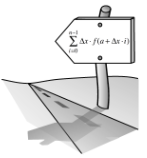
2.4.1How can I write sums?
Improving Approximation
Sketch a sine wave on
The left endpoint rectangles are an overestimate of the actual area.
The left endpoint rectangles are an underestimate of the actual area.
The right endpoint rectangles are an overestimate of the actual area.
The right endpoint rectangles are an underestimate of the actual area.
The left endpoint rectangles and right endpoint rectangles yield equal areas.
Explore using the Estimating Area Under a Curve eTool . Click in the lower right corner of the graph to view it in full-screen mode.
Examine the graph at right. Use the graph to complete parts (a) and (b) below.
Assume that an area is being estimated using
rectangles of equal width. Write an expression for using and . As the number of rectangles increases, what happens to the width of each rectangle?

Rewrite the following Riemann sum by substituting your expression for
Changing the value of
OUT OF GAS, Part Two
After arriving at Calculus Camp, J.T. and Elena realized that they could have made a much better estimate of the distance traveled after running out of gas than they had in problem 2-1. Elena suggested using a function to approximate the data, thereby allowing them to use a Riemann sum.
Elena discovered that
represents a curve of best fit for the data in problem 2-1. Sketch this curve on your calculator, making sure you can see a complete picture of Elena and J.T.’s road trip. Use sigma notation to write two Riemann sums that approximate the distance traveled. Write one expression for the left endpoint and one expression for the right endpoint rectangles. Assume that the area is divided into
rectangles. Consider the shape of the graph. Will left endpoint rectangles generate an over or and underestimate of the actual area? Justify your answer.
Have each member of your team choose a different number of rectangles (
etc.) and calculate the corresponding distances using both right and left endpoint rectangles. Share this information with your team—keep a detailed record of everyone’s findings. Use your calculator so you have time to record many different values for . What happens as increases? How can Elena get the best estimate? How many rectangles should she use? Should they be left or right endpoint rectangles?

Sketch a graph of the region bounded by the functions
How can you estimate the area in this region?
Using your method, estimate the area of the region.
Write a single expression using the Trapezoid Rule, which will approximate the area under
Examine the scenarios below, paying attention to the units. Homework Help ✎
While walking to school, Jaime’s distance from home (in miles) was
, where is measured in hours. Sketch a graph of his distance. If it takes Jaime minutes to walk to school, what is his average velocity? Explain how you got your answer. While walking home, Jaime walks so that his velocity (in miles per hour) is
, where is measured in hours. How long does it take him to get home?
Write an expression that will calculate the slope between
WHICH IS BETTER? Part Three
Below is a comparison of using different numbers of rectangles to approximate the same area under a curve for
If, in each situation, the rectangles all have equal widths, write expressions to approximate the areas under the curves.
rectangles .png)
rectangles .png)
rectangles .png)
A tangent line is drawn to the curve
.png)
Determine the values of the following limits. If the limit does not exist, indicate why not. Homework Help ✎
Review the three conditions of continuity. Then, examine the graph below and determine at which values of
.png)
Use the graph from problem 2-143 to complete the following table: Homework Help ✎
Continuous | |||


